The fastest way to grow a newsletter from zero is usually to promote every edition on the social platforms where your readers already spend time. For most writers, that means X and LinkedIn. Newsletter Operator says 70 to 80% or more of your first 1,000 subscribers come from social posting. Recommendations and swaps work better once you have some readers, and paid ads are fast but cost money. SEO and YouTube are the slowest. I am the founder of Letterly, which automates social posting, so I am biased toward that method. I ranked seven methods with the same four filters, mine included.
Disclosure: I am Vicente Évora, the founder of Letterly. Letterly automates social posting, which is one of the seven methods below. I ranked every method with the same four filters and wrote down what each one costs you.
What does it mean to grow a newsletter fast?
To grow a newsletter fast is to get your first subscribers in days or weeks, not months. It does not mean overnight results. Most of the methods below are free, and one is paid.
In my view, growing a newsletter from zero is mostly a distribution problem, not a writing problem. Newsletter Operator makes a similar point. It says newsletter content is rarely discovered or shared the way social posts are, so you have to build an audience on social to grow a newsletter.
Who is this guide for?
This guide is for writers with a newsletter under about 5,000 subscribers who publish regularly and have little time left for promotion.
It is not for large publishers with a marketing team or an ad budget.
The problem is easy to recognise. You publish every week and the list barely moves. Your friends and family signed up in week one, and it has been quiet since.
How did I rank the methods with the Letterly Four-Filter Test?
The Letterly Four-Filter Test is how I rank the options in my guides. Every option gets the same four filters, asked in the same order, and that includes anything I sell. For growth methods, the filters are:
Filter 1. How quickly does it bring your first subscribers?
Filter 2. What does it cost?
Filter 3. How much weekly effort does it take?
Filter 4. Does it work with a small list?
The ratings are my own judgment. Where I cite a number, I link the source. I automate social posting with Letterly, so apply extra scepticism to how I rate it.
There are seven main ways to grow a newsletter. Some bring readers within days, and others take months to pay off.
Social media posting. Promote each edition on X, LinkedIn and similar platforms, with a signup link.
Recommendations and cross-promotion. Other newsletters recommend yours to their readers.
Lead magnet and signup page. A free resource that readers get in exchange for their email address.
Direct outreach. Personal messages to people who would genuinely like your newsletter.
Communities. Taking part helpfully in places such as Reddit, without spamming.
Paid ads and sponsored newsletter ads. Paying to reach new readers.
SEO and YouTube. Content that people find through search over time.
How do the growth methods compare on speed, cost and effort?
Paid ads and direct outreach bring the first subscribers soonest. Social posting and communities take days to weeks. Recommendations and lead magnets take weeks, and SEO and YouTube take months. Most methods cost time instead of money, but paid ads cost money, and recommendations can too.
Seven ways to grow a newsletter, fastest first
Each bar shows when a method usually brings your first subscribers. The dots show weekly effort. These are my own ratings.
ImmediateDaysWeeksMonthsCost and effort
Paid ads
First subscribers: Immediate
Cost: PaidWeekly effort: Low
Direct outreach
First subscribers: Days
Cost: FreeWeekly effort: Medium
Social posting
First subscribers: Days to weeks
Cost: FreeWeekly effort: High, unless automated
Communities
First subscribers: Days to weeks
Cost: FreeWeekly effort: Medium
RecommendationsBetter after about 500 subscribers
First subscribers: Weeks
Cost: Free to paidWeekly effort: Low
Lead magnetNeeds traffic
First subscribers: Weeks
Cost: FreeWeekly effort: One-time build
SEO and YouTubeA long-term bet
First subscribers: Months
Cost: FreeWeekly effort: High
of your first 1,000 subscribers come from posting on social, according to Newsletter Operator.
70 to 80% or more
The seven methods, fastest first. Speed, cost and effort are my own ratings, from the table below. The 70 to 80% figure is from Newsletter Operator.
How the seven growth methods compare, by my own ratings
Method
Time to first subscribers
Cost
Weekly effort
Works with a small list?
Social posting
Days to weeks
Free
High, unless automated
Yes
Recommendations
Weeks
Free to paid
Low
Better after about 500 subscribers
Lead magnet
Weeks, and it needs traffic
Free
One-time build
Yes, but it needs traffic
Direct outreach
Days
Free
Medium
Yes
Communities
Days to weeks
Free
Medium
Yes
Paid ads
Immediate
Paid
Low
Yes, at a cost
SEO and YouTube
Months
Free
High
Yes, but it is slow
Other guides sort the tactics differently. beehiiv lists recommendations, sponsored newsletter ads and paid social ads as quick wins, and puts growing your social presence in a slower group. My ranking asks a narrower question: what brings a small list its first subscribers. Newsletter Operator’s answer to that is social.
Which growth method is best for which writer?
No method is best for everyone. Choose by where your readers are, how much time you have and what you can spend.
Is social media posting the fastest way to grow a newsletter?
Best for writers whose readers already use X or LinkedIn. For most small newsletters it is the fastest free method. Newsletter Operator says 70 to 80% or more of your first 1,000 subscribers come from it, and GetResponse calls social media one of the most effective tools for promoting a newsletter.
The trade-off is effort. You write the newsletter, and then you write the posts, every week. Newsletter Operator suggests starting with five posts a week, one each weekday, on a schedule you can keep for 30 days. It adds that repurposing your newsletter makes consistent posting easier.
Best for writers who already have some readers to trade with. beehiiv reports that Jack Raines got over 8,000 subscribers from Recommendations alone over 18 months. Newsletter Operator suggests swapping recommendations with other small newsletters once you pass 500 subscribers. GetResponse adds that cross-promotion works best with newsletters on related topics that do not compete with yours.
The trade-off is that it starts slowly. Nobody recommends a brand-new newsletter with 12 subscribers.
Should you build a lead magnet?
Best for writers who already have traffic from another source. A lead magnet is a free resource that readers get in exchange for their email address. It turns visitors into subscribers, but it does not bring visitors by itself.
Does direct outreach work?
Best for your first few dozen subscribers. It works because it is personal.
The trade-off is that it does not scale and takes real time.
Is it worth joining communities like Reddit?
Best for writers who really take part in a community, not just show up to promote. Help first, and mention your newsletter only where it answers the question.
The trade-off is that it takes steady, genuine effort.
Should you pay for subscribers or ads?
Best for writers with a budget and a way to turn subscribers into revenue. Newsletter Operator says paid ads work much better after you have traction, subscribers and revenue from your newsletter. beehiiv lists sponsored newsletter ads and paid social ads among its quick wins.
The trade-off is cost. Paying for ads is not the same as buying an email list. With ads, readers choose to sign up. GetResponse warns against buying a list, because a bought list harms your deliverability and brings passive subscribers who may report your emails as spam.
Are SEO and YouTube worth it for a new newsletter?
Best for a long-term bet next to something faster. beehiiv files SEO and YouTube under long-term growth strategies that it says pay dividends for years. They can pay off, but they will not help in your first month.
What happened when I promoted one edition on social?
Social posting is the method I automated, so this is where I can show real numbers. I ran one edition of my own newsletter, Notes to 10K MRR, through Letterly’s agent. This is a sample of one, so treat it as a single real run, not a benchmark.
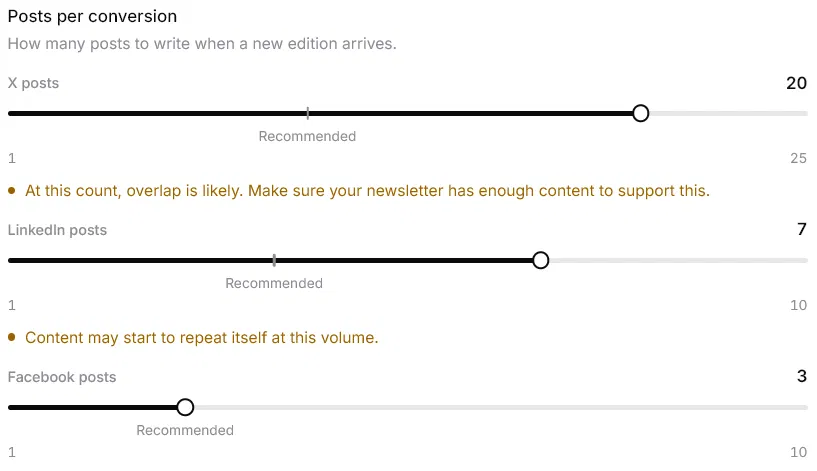
I set the post counts myself: 20 for X, including a thread, 7 for LinkedIn and 3 for Facebook. Letterly warns that overlap is likely at 20 X posts, and that LinkedIn posts may start to repeat at 7. Push the sliders that far only if your edition has enough in it. Mine did.
The post counts for this run, as I set them in Letterly’s agent settings.
Here is what came out:
X 20
LinkedIn 7
Facebook 3
Clicks across all platforms
129
New subscribers
29
Edition images used
3 of 3
One edition, one agent run: 30 posts by platform, and what the edition brought back. These are the figures from my own run.
30 posts in total. That was 20 posts on X, including a thread, plus 7 on LinkedIn and 3 on Facebook.
All 3 images used. My edition had three images. Letterly pulled all of them and attached each one to the posts it matched.
129 clicks and 29 new subscribers. The edition brought 129 clicks across all platforms and 29 new subscribers.
No time in the app. I did not open Letterly to run it.
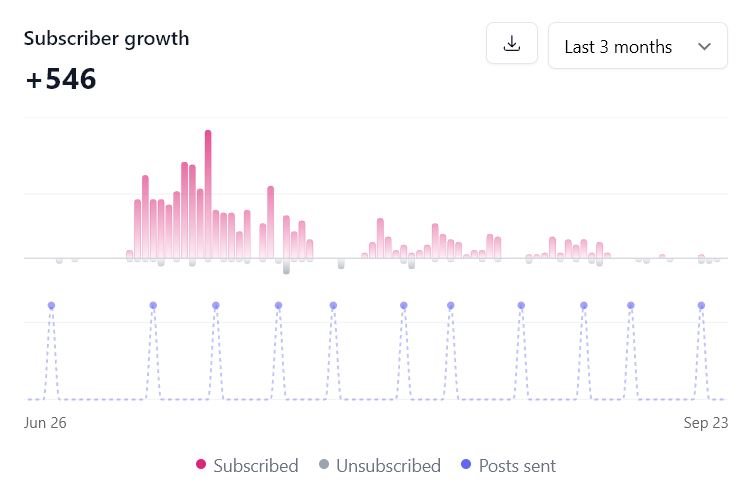
Over a longer stretch, my newsletter grew by 546 subscribers in the three months to 23 September 2026, while Letterly posted every edition for me. The chart is beehiiv’s own growth graph. It shows all growth, not growth by source, so it does not prove that Letterly caused it.
Subscriber growth for Notes to 10K MRR from 26 June to 23 September 2026, from beehiiv. The dots mark each edition sent.
What does it cost to automate social posting?
Letterly costs $29 a month on one plan that includes every feature and all four platforms. The first seven days are free, and the free plan includes one full agent run on your latest edition, so you see real posts before you pay.
Letterly connects to your newsletter’s RSS feed, detects each new edition and turns it into scheduled posts for X, LinkedIn, Threads and Facebook Pages. Setup takes about ten minutes.
The trade-offs are real. Letterly has no Instagram or TikTok. Threads reuses your X content instead of getting its own writing. One person builds Letterly, so a bug or two may still turn up.
One user has written about it publicly on X. I picked this quote myself, so it is not a random sample.
“Been using Letterly lately and it's nice not having to think about that part anymore.”
Promoting each edition on social media with a signup link, in the places your readers already use. Newsletter Operator says 70 to 80% or more of your first 1,000 subscribers come from social, most often X or LinkedIn.
How long does it take to grow a newsletter?
It varies a lot, and anyone who promises a fixed number is guessing. Newsletter Operator suggests posting consistently for 30 or more days before you judge the results.
How many subscribers do I need before newsletter swaps work?
Newsletter Operator suggests about 500, before you swap recommendations and promotions with other small newsletters in your niche.
Should I grow on X or LinkedIn?
Pick the one your readers already use. Newsletter Operator suggests starting with one or two platforms. Letterly posts to both, plus Threads and Facebook Pages.
How often should I post to grow a newsletter?
Newsletter Operator suggests starting with five posts a week, one on each weekday, and keeping that schedule for 30 days.
Can I automate promoting my newsletter on social media?
Yes. Letterly watches your RSS feed and turns each new edition into scheduled posts, without you opening the app.
Do newsletter recommendations really work?
They can. beehiiv reports that Jack Raines got over 8,000 subscribers from Recommendations alone over 18 months. They work best once you have some readers, so they are slow to start.
Is buying subscribers a good idea?
No. Paying for ads can work, but buying an email list does not. GetResponse warns that bought lists harm your deliverability and bring passive subscribers who may report your emails as spam.
Will promoting on social guarantee new subscribers?
No, and I cannot promise a number. In my own test, one edition brought 129 clicks and 29 new subscribers. That is a sample of one, and your results depend on your audience and your posts.
What changed since the last update?
First published on letterly.pro. I checked every number I cite against its source page on this date, and the sources section links each one.
About LetterlyHow the agent works, the autonomy levels and the key facts.
About the author
Vicente Évora
Founder of Letterly
Vicente writes Notes to 10K MRR, a weekly build-in-public newsletter on beehiiv, alongside university and a part-time job. Every edition went out on time, and the social posts that were supposed to follow it never did.
He built Letterly to write those posts for him. It started as an idea on 26 November 2024, and the first version shipped in January 2025. Letterly is built and run by one person, and Vicente answers support email himself.